Challenge
Start with the participant’s real assumption, question or business problem.

2EA combines China, technology and business insight with highly interactive facilitation. Sessions are built around real questions, not generic content.
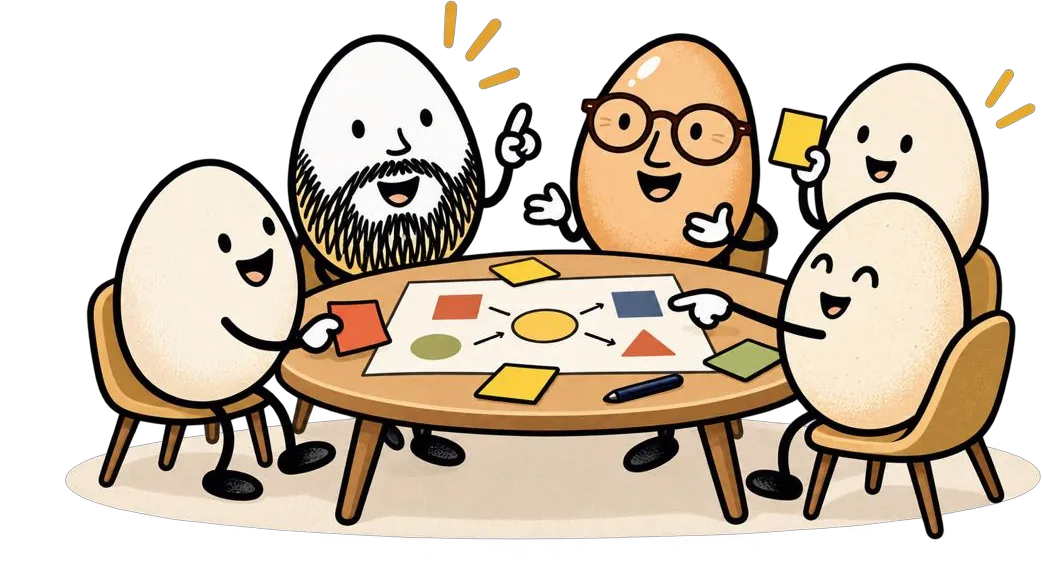
Information can be delivered in a presentation. A workshop should change what participants notice, question or do.

Every 2EA session is designed around interaction, comparison and application.
Built around the audience and the business question they are actually working on.
Participants work, discuss and challenge — in the room and in small groups.
Every session ends with a useful output: questions, experiments or decisions.
Start with the participant’s real assumption, question or business problem.
Introduce relevant Chinese business models, technologies, behaviours or ecosystem examples.
Separate what is driven by technology, incentives, market structure, policy, culture or organisational behaviour.
Turn the new perspective into a question, experiment, decision or next action.
Available as standalone sessions or partner-integrated programmes.
Perspective Lab
A highly interactive session that combines specialist insight, contrasting perspectives, facilitated discussion and application.
Challenged assumptions, sharper questions and a clearer perspective on the issue.
Innovation Workshop
Participants bring a live organisational or innovation question. 2EA introduces relevant China and technology comparables, then facilitates the group through Challenge → Compare → Reframe → Apply.
A reframed challenge and practical experiments, actions or decisions to test.
Embedded Learning Track
Preparation, specialist workshops, immersion framing and follow-through integrated into an existing leadership journey, executive programme, conference, association programme or China immersion.
2EA adds the specialist China / innovation layer where it creates the most value.
Eight starting points, from technology and business models to leadership thinking. Each session is built around your group’s question, so a topic is a lens, not a syllabus.
Speed, experimentation, implementation, ecosystems and the assumptions behind Chinese innovation.
What would we do differently if we could experiment at Chinese speed?
How organisations move from AI awareness to experimentation, workflows and new operating models — including what Western leaders can learn from Chinese adoption patterns.
Are we waiting for permission where we should be learning through controlled experimentation?
Why technically available tools still fail to become organisational capability — and how leaders reduce the gap between awareness and use.
What is really preventing adoption in our organisation?
Platforms, partnerships, integrated ecosystems and different ways of structuring value.
Are we looking at the product when the competitive advantage sits in the ecosystem?
Chinese and Western assumptions around decisions, trust, communication, incentives and collaboration.
Why can two rational teams look at the same opportunity and reach different conclusions?
Thinking and behavioural frameworks from Chinese strategic and philosophical traditions, read as practical lenses on leadership today.
Which of our leadership reflexes would a Chinese strategist read completely differently?
Operating models inside Chinese companies: speed, hierarchy, incentives, founder-led execution and the interplay between state and private players.
What would our organisation have to change to decide and execute at that pace?
Robotics, energy, biomedical, manufacturing and other fast-moving sectors used as live contexts for the workshop.
What does this sector reveal about how innovation is actually moving?
Energy, robotics, biomedical and AI demonstrate depth. They are contexts for a session, not separate practices.
Two example flows. Timing and sequence are adapted to the group; treat these as illustrations, not a fixed agenda.
| 10 min | Framing: the question on the table |
| 20 min | Contrasting perspective and cases |
| 30 min | Facilitated discussion |
| 20 min | Small-group or individual exercise |
| 20 min | Reframe and implications |
| 10 min | Commitments and closing |
Surface the assumption behind the live question.
Relevant China and technology comparables.
Pull the comparison apart: what transfers, what does not, and why.
Agree the sharper version of the question.
Small, testable, owned.
Peers and facilitators challenge each plan.
A global consumer-goods leadership cohort used China as a lens on AI-enabled commerce. The value was not another company visit: it was a different set of questions about experimentation, local capabilities and what to adapt at home.































Organisations Johnny and Nil have advised, trained, worked for or worked alongside over two decades. Logos reflect the partners’ individual track records.
Workshops, panels, keynotes and delegation sessions in Beijing, Shanghai and beyond. Click a photo to enlarge.
Thank you for the impressive workshop yesterday! It was truly fruitful, and we are delighted to see our key talents shift their mindset and set actionable goals to leverage AI tools in the appropriate areas.
We ask about these in the first conversation. They decide the format, the examples and the exercises.
Seniority, sector, prior China exposure and group size.
The live question or assumption the group wants to test.
Standalone, inside a programme, at a conference or during an immersion.
Online, in person or blended; 90 minutes to a full day.
Tell us the audience and the question. We will propose the simplest format that can create value.